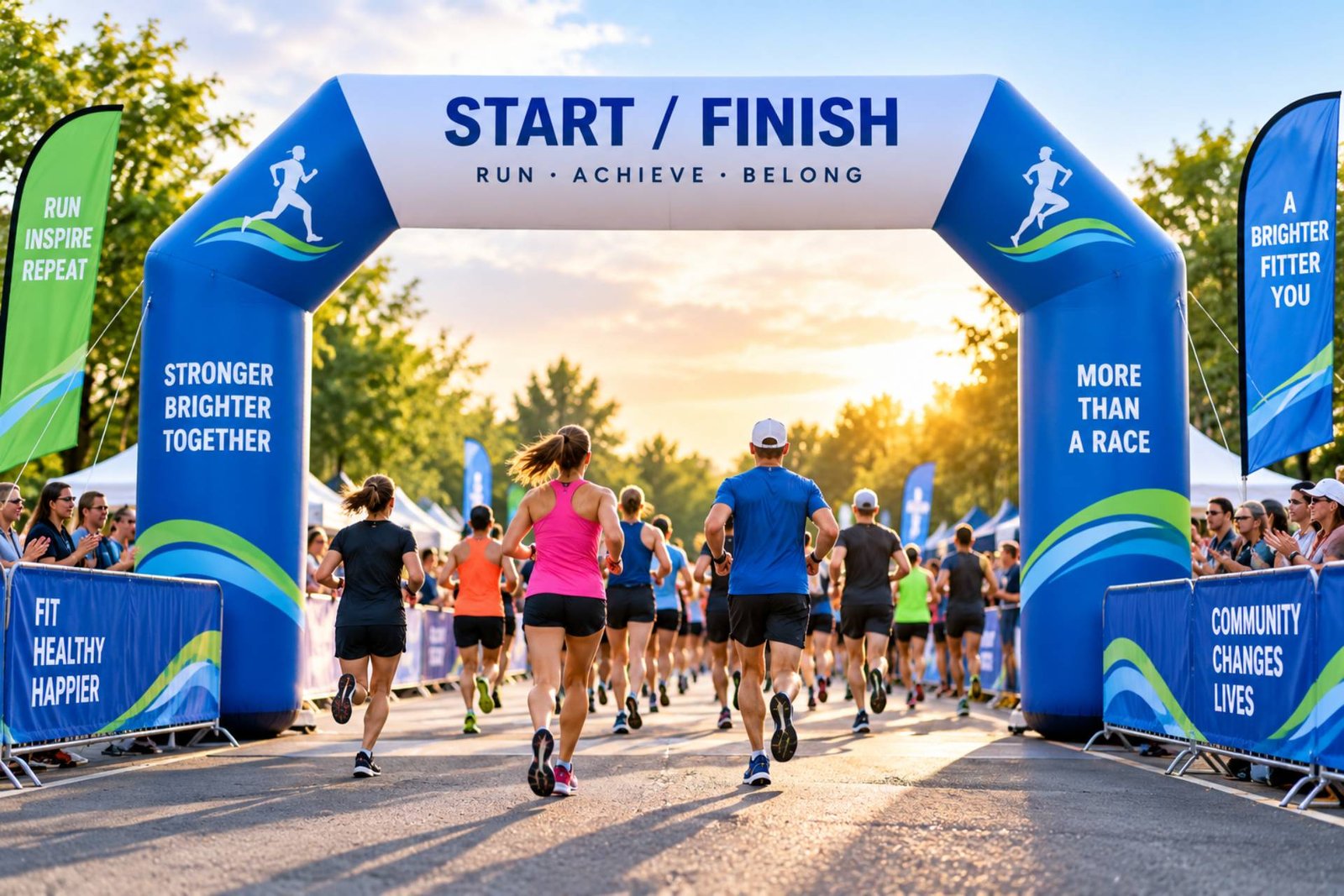
Inflatable arches have become a familiar sight at races, fun runs and product launches. They mark the start and finish lines, create clear entrances and give organisers a large, visible surface for branding. When chosen and used well they improve the experience for participants, help spectators orient themselves and deliver strong visual impact for sponsors.
A well-specified inflatable arches setup can turn an ordinary start line into a memorable focal point. The key is matching the arch to the scale of the event, the site conditions and the practical needs of the day rather than treating it as decoration alone.
Why Inflatable Arches Work for Events
These structures are portable, quick to deploy and highly visible from a distance. At a race they give runners a clear target to aim for. At a launch they create an obvious gateway that draws people in and frames photographs. Because they can be printed with logos, event names or sponsor artwork, they also serve as mobile advertising that stays in view throughout the day.
They are not permanent fixtures. Most rely on continuous airflow from an electric blower, so a reliable power source is essential. Once inflated and properly anchored they remain stable in normal outdoor conditions, provided the site is suitable and the securing system is adequate.
Choosing the Right Size and Style
Start by measuring the space. A typical race start or finish needs enough width for groups of runners to pass comfortably and enough height for safety and visibility. Smaller arches suit local 5K events or indoor launches; wider spans work better for larger fields or main-road crossings. Consider the approach paths, spectator areas and any overhead obstacles such as trees or overhead cables.
Style matters for both function and appearance. Simple tubular arches are straightforward and widely used. More complex designs with extra uprights or supporting walls can provide additional branding space or a more distinctive silhouette. Decide early whether the arch needs to carry start and finish banners that can be swapped, or whether a single fixed design is sufficient.
Custom printing allows full-colour logos and messaging on both sides. Plan the artwork so text remains readable from a distance and important information is not lost when the arch is viewed at an angle.
Practical Considerations for Setup and Safety
Location is critical. Choose ground that is reasonably level and free from sharp objects. The arch must be secured with stakes, weights or ballast appropriate to the surface and expected wind. Too little anchoring is a common cause of problems; experienced suppliers stress that thorough securing is non-negotiable.
Power is another practical requirement. Continuous-air models need electricity for the blower throughout the event. Arrange a safe, weather-protected supply and keep cables away from foot traffic. Check local regulations for outdoor electrical equipment and any permits required for temporary structures on public land or roads.
Weather should influence planning. Durable PVC and nylon materials handle typical outdoor conditions, yet strong winds or heavy rain may require extra ballast, temporary deflation or relocation. Have a clear decision point for when conditions become unsuitable.
Maximising Branding and Participant Experience
Place the arch where it creates the strongest visual impact without obstructing flow. At races this usually means the start and finish lines; at launches it often works best as an entrance or photo backdrop. Leave clear space in front and behind so runners or guests can approach and pass through comfortably.
Use the large surface area deliberately. Sponsor logos, event titles and directional messaging all perform better when they are high, bold and repeated on both faces. Removable banners add flexibility if the same arch serves multiple functions during the day.
For participants the arch becomes part of the memory of the event. A well-branded finish line gives runners a clear goal and a natural place for celebration photographs. At product launches it signals arrival and creates an obvious gathering point.
Logistics and Reuse
Inflatable arches pack down into manageable bags and are relatively light for their size, making transport between events practical. Rental options suit one-off occasions, while purchase makes sense for organisations that run regular races or campaigns. Custom manufacture typically takes several weeks, so order early if specific branding or sizes are required.
After the event, clean and dry the fabric before packing to prolong its life. Inspect seams, valves and anchoring points regularly. Store away from sharp objects and extreme temperatures.
Common Pitfalls to Avoid
Underestimating wind loading is the most frequent issue. Always follow the supplier’s anchoring guidance and increase ballast if the forecast looks unsettled. Insufficient power or poorly sited cables create safety and operational problems. Artwork that is too detailed or low-contrast loses impact when viewed from a distance. Finally, treating the arch as an afterthought rather than integrating it into the overall site plan reduces its effectiveness.
Making the Arch Work Harder
Think beyond the single structure. Combine the arch with complementary elements such as branded barriers, flags or temporary signage to reinforce wayfinding and sponsor presence. At larger events, using matching arches at intermediate points can help maintain a consistent visual identity along the course.
For launches, position the arch so that it frames key product displays or the main stage. Lighting can extend its usefulness into the evening if the event continues after dark, though any additional electrical load must be planned carefully.
Getting Reliable Results
Successful use of inflatable arches rests on clear requirements, early planning and attention to practical details. Measure the site, decide the primary functions (start/finish, entrance, branding), confirm power and anchoring arrangements, and allow enough lead time for custom work. When these elements are handled well, the arch becomes a functional landmark that improves organisation, enhances the atmosphere and delivers value for organisers and sponsors alike.
Period properties and modern extensions may share similar floor areas yet differ markedly in heat loss; the same principle applies here. Different events impose different demands of space, weather exposure and branding intensity. Accurate assessment of those demands, combined with proper securing and power arrangements, is what turns an inflatable arch from a decorative item into a reliable working part of the event.