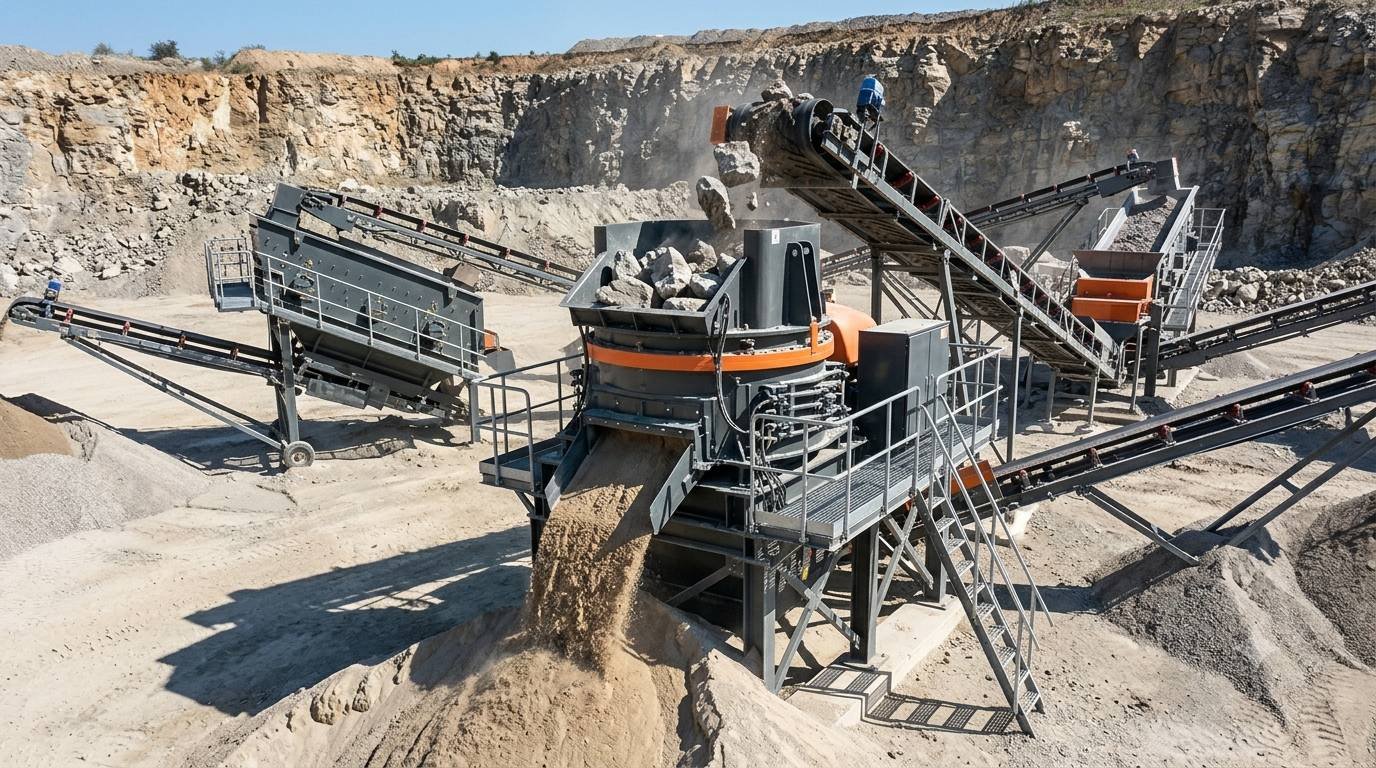
Aggregate quality depends on more than achieving the correct nominal size. Particle shape, grading, surface texture and fines content influence how concrete mixes, how asphalt compacts and how finished materials perform. A controlled tertiary or quaternary shaping stage can correct weak particle geometry before aggregate reaches the final stockpile or mixing plant.
Primary and secondary crushing reduce rock efficiently, but they may leave elongated, flaky or uneven particles in the product stream. These shapes can affect concrete workability, asphalt compaction and compliance with aggregate specifications. A tertiary CV216 VSI impact crusher can provide a controlled shaping stage for quality aggregate production, road construction and concrete products. The machine accepts feed up to 50 millimetres and has a published capacity range of 51 to 121 tonnes per hour. Yet equipment selection alone cannot guarantee quality. Stable feed, correct settings, effective screening and regular testing must work together to produce consistent, specification-ready aggregate.
Shape Begins With the Complete Crushing Circuit
Every crushing stage influences the product received by the next machine. Poor blasting or uncontrolled primary crushing can send large variations in size and hardness through the plant.
A shaping crusher performs best when its feed remains within the stated size limit and arrives at a controlled rate. Oversized rock can reduce stability, while irregular flow changes the crushing action.
Review the whole circuit before adjusting the final stage. A problem that appears in the finished aggregate may begin at the quarry face, feeder or secondary crusher.
Why Cubical Aggregate Matters in Concrete
Concrete needs aggregate particles that pack well while leaving enough paste to coat their surfaces. Flaky or elongated particles can increase voids and make the mix harder to place.
A more cubical shape can support workable mixtures and consistent compaction. It may help reduce the need to correct poor particle geometry through higher binder or water demand.
Shape is only one factor. Strength, cleanliness, grading, absorption and resistance to wear must still meet the required concrete specification.
How Particle Shape Affects Asphalt
Asphalt relies on a stable aggregate skeleton. Angular, well-shaped particles can interlock under compaction and help the mixture resist movement under traffic.
Excessive flat or elongated material may orient poorly during laying. This can contribute to variable density and weaker internal structure.
The best shape depends on the asphalt design and specified aggregate category. Plant teams should compare crusher settings with laboratory results rather than judging quality by appearance alone.
Grading Must Remain Controlled
A shaping stage can change both particle form and size distribution. Stronger crushing action may produce more fine material, affecting the final grading curve.
Screen performance is critical. Damaged media, blocked apertures or overloaded decks can send off-size particles into finished stockpiles.
Sample each product fraction at suitable intervals. Trend the results so gradual movement becomes visible before the aggregate falls outside specification.
Use the VSI for Its Intended Duty
The CV216 VSI impact crusher is designed for tertiary and quaternary applications. It can process hard and abrasive rock as well as softer, moist or sticky materials, subject to correct plant design and operation.
Its published motor power is 110 kilowatts, while rotor speed varies with the electrical frequency and selected operating conditions. These figures help with circuit planning but do not predict exact site output.
Actual performance depends on feed grading, material properties, moisture, rotor setup and required product. Testing and commissioning should confirm the operating window.
Balance Shape Improvement Against Fines
Greater impact can improve particle form, but it may increase fines production and wear. The target is not maximum breakage. It is the lowest practical cost for material that meets the required specification.
Monitor fines percentage alongside shape tests, power draw and wear-part consumption. A setting that produces attractive aggregate may still be uneconomic if usable yield falls sharply.
Where possible, return suitable oversize material through a controlled recirculating circuit. Avoid uncontrolled recirculation that overloads the crusher or screen.
Protect Consistency Through Maintenance
Worn components can change rotor balance, particle acceleration and product grading. Small mechanical changes may appear first as movement in laboratory results.
Inspect wear parts at planned intervals and record their condition. Replace parts according to measured wear and approved maintenance guidance rather than waiting for failure.
Quick wear-part replacement can reduce downtime, but preparation still matters. Keep suitable spares, lifting tools and inspection procedures ready before stopping the machine.
Test the Final Product, Not the Crusher Claim
A crusher can support quality aggregate production, but compliance belongs to the final product. Sampling must represent the actual stockpile or production stream.
Check grading, particle shape, fines and other properties required by the intended concrete or asphalt specification. Use consistent sampling and laboratory methods.
Separate stockpiles clearly and control contamination from ground surfaces, loaders and neighbouring products. Good crushing cannot correct poor handling after production.
Frequently Asked Questions
Does a VSI only make sand?
No. A VSI can shape and crush different aggregate fractions within its feed and operating limits.
Can cubical aggregate reduce concrete cement content?
It may support better packing and workability, but mix design, grading and material properties determine the final binder requirement.
Does higher rotor speed always improve shape?
No. Higher speed changes the crushing action and may increase fines, wear and power demand. Results should be confirmed through testing.
Why does product grading change as parts wear?
Wear can alter the machine’s internal geometry and particle acceleration, affecting breakage and size distribution.
Can one crusher setting serve concrete and asphalt products?
Not always. Each product may have different grading and shape requirements, so settings and screening arrangements may need adjustment.
Conclusion
Producing specification aggregate requires control from the quarry face to the finished stockpile. Primary and secondary crushers reduce material, while the later shaping stage can improve particle geometry and adjust grading. These changes influence concrete workability, asphalt compaction and the stability of the finished mixture.
Operators should maintain a steady feed, protect screen efficiency and test shape, grading and fines regularly. Power draw, wear-part condition and usable yield should be reviewed with laboratory data. The most attractive particle is not automatically the most economical if shaping creates excessive fines or wear.
Stockpile management remains important because contamination and segregation can undo careful processing. The final product, not the machine alone, must meet the project specification. When correctly selected and operated within a balanced circuit, the CV216 VSI impact crusher can provide the tertiary or quaternary shaping needed for consistent concrete aggregate, asphalt aggregate and road-construction materials.